Every year, around November, Bangkok’s sky turns grey again. Thailand’s Pollution Control Department says October and November are when the air goes still and dust starts to build up, while the North is worst during the December–April haze season, usually peaking in March.
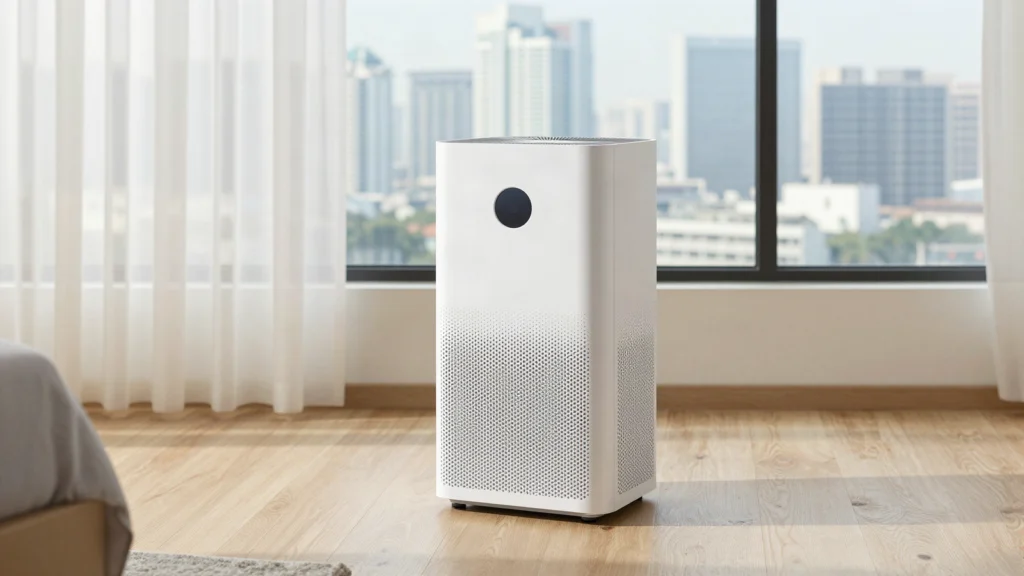
Thailand cut its 24-hour PM2.5 standard to 37.5 µg/m³ on 1 June 2023, but the World Health Organization (WHO) recommends 15. So even on days that are “within the standard”, the air may not be good enough for children, older people and anyone with allergies. A closed room with a properly sized air purifier is the most effective place to hide from the dust at home.
The problem is that box claims like “for rooms up to 48 m²” or “100 m²” cannot be compared, because every brand calculates them differently. So we compared 7 air purifiers sold in Thailand by their CADR, the one figure that is measured the same way for everyone, and worked out the right room size, yearly filter cost and electricity cost for each.
How we made this comparison
We chose models with an official distributor or shop in Thailand, took the specs from each brand’s website, checked prices at HomePro, BNN and the brands’ official shops on 13 October 2026, and used the February 2026 test of 15 air purifiers by Chaladsue magazine and the Thai Consumers Council where a model was included. We did not lab-test the machines ourselves; scores are our editors’ scores. How we choose
The 30-second answer
- Best overall Xiaomi Smart Air Purifier 4 Lite CADR 360 for under ฿4,000, with a PM2.5 sensor, and it matched its label in Chaladsue’s test about ฿3,590–3,990
- Living rooms LG PuriCare 360 Hit CADR 483 and an H13 HEPA filter at a very good sale price about ฿6,900
- Small budget, small bedroom Xiaomi Smart Air Purifier 4 Compact the cheapest model with a published CADR, and it draws only 27 W about ฿2,240–2,290
- Quietest for bedrooms Philips AC0950 just 20.5 dB in sleep mode, and no ionizer about ฿6,090
- No app needed Sharp FP-J30TA simple buttons, and a filter that lasts up to 2 years about ฿2,460–2,740
- Longest warranty Hatari AP12R1 a Thai brand with a 3-year warranty and no ionizer about ฿2,988
- Big rooms and open plan Xiaomi Smart Air Purifier Elite CADR 600, the highest in this guide about ฿8,990–11,990
3 numbers to know before you buy
37.5 µg/m³Thailand’s 24-hour PM2.5 standard since 1 June 2023 (previously 50)
15 µg/m³the WHO’s recommended 24-hour PM2.5 level (2021 guidelines)
CADR × 12rule of thumb: CADR in m³/h should be about 12 times the floor area in m²
Hourly and 24-hour PM2.5 readings for your area are on the Air4Thai website and app from the Pollution Control Department. When the reading is orange (37.6–75) or red (75.1 and above), close the windows and keep the purifier running.
Air purifier comparison table: 7 models
We calculated the “suits a room of” column from each CADR using the AHAM rule (the US Association of Home Appliance Manufacturers). Every model goes through the same formula, so the column compares far better than the numbers on the boxes.
| Model | CADR (m³/h) | Suits a room of* | Filter | Ionizer / plasma | Price (฿) |
|---|---|---|---|---|---|
| Xiaomi 4 Lite | 360 | ~30 m² | 3-in-1 + carbon (no HEPA grade stated) | No | 3,590–3,990 |
| LG PuriCare 360 Hit | 483 | ~40 m² | HEPA H13 + odour filter | Yes (Plasmaster) | ~6,900 |
| Xiaomi 4 Compact | 230 | ~19 m² | 3-in-1 (no HEPA grade stated) | No | 2,240–2,290 |
| Philips AC0950 | 250 | ~20 m² | HEPA NanoProtect + carbon | No | ~6,090 |
| Sharp FP-J30TA | not published | 23 m² (brand) | HEPA + deodorising | Yes (Plasmacluster) | 2,460–2,740 |
| Hatari AP12R1 | not published | 20–32 m² (brand) | HEPA12 + carbon | No | ~2,988 |
| Xiaomi Elite | 600 | ~49 m² | 3-layer + carbon | Yes (plasma + UV-C) | 8,990–11,990 |
The 7 air purifiers, reviewed in detail
No. 1
Best overall
Xiaomi Smart Air Purifier 4 Lite
4.6/5 our score
About ฿3,590–3,990 (list price ฿4,999–5,490)
- CADR360 m³/h
- Suitsabout 30 m² (brand says 25–43)
- Filter3-in-1 with carbon, 99.97% at 0.3 microns
- Sensorlaser PM2.5
- ControlXiaomi Home app
- Max power33 W
- Noise33.4–61 dB
- Replacement filterabout ฿1,229–1,590 every 6–12 months
Pros
- Best CADR per baht under ฿5,000
- The AC-M17-SC matched its label in Chaladsue’s test
- App shows dust levels, schedules and filter reminders
Cons
- Top speed reaches 61 dB, too loud for sleeping
- Xiaomi does not grade the filter to a HEPA standard
Our verdict: If you can only buy one machine for a large bedroom or a one-bedroom condo of up to about 30 m², start here. It cleans almost as fast as machines that cost twice as much, and filters are easy to find.
No. 2
Best for living rooms
LG PuriCare 360 Hit (AS60GHWG0)
4.4/5 our score
About ฿6,900 (list price ฿9,900)
- CADR483 m³/h
- Suitsabout 40 m² (brand says 61)
- FilterHEPA H13 + odour filter
- SensorPM1.0 and gas
- IonizerPlasmaster Ionizer
- ControlWi-Fi, LG ThinQ app
- Max power41 W
- Warranty1 year
Pros
- CADR close to 500 for under ฿7,000 on sale
- H13 filter, at least 99.95% under EN 1822
- Draws air from all 360 degrees, so it can stand mid-room
Cons
- Has an ionizer: if ozone worries you, check the manual for a way to switch it off
- We could not find the replacement filter price at official Thai shops
- Only a 1-year warranty
Our verdict: Made for living rooms of 35–45 m². At a sale price near ฿7,000 it is the best value for large rooms, but check the filter price before you buy.
No. 3
Best on a small budget
Xiaomi Smart Air Purifier 4 Compact
4.2/5 our score
About ฿2,240–2,290 (list price ฿2,990–3,290)
- CADR230 m³/h
- Suitsabout 19 m² (brand says 16–27)
- Filter3-in-1, 99.97% at 0.3 microns
- Sensorinfrared PM2.5
- ControlXiaomi Home app
- Max power27 W
- Quietest20 dB (sleep mode)
- Replacement filterabout ฿939 every 6–12 months
Pros
- Cheapest model here that still publishes its CADR
- Very low power use, fine to run all day
- Filter costs under ฿1,000
Cons
- For small rooms only, not over 20 m²
- Xiaomi itself says the filter is not a standard HEPA
Our verdict: The best answer for a 12–20 m² condo bedroom or a child’s room. For anything bigger, move up to the 4 Lite rather than running a small machine flat out.
No. 4
Quietest for bedrooms
Philips AC0950/10 (PureProtect Mini 900)
4.1/5 our score
About ฿6,090 (list price ฿6,990)
- CADR250 m³/h
- Suitsabout 20 m² (brand says up to 65)
- Filterpre-filter + HEPA NanoProtect + carbon
- Ionizernone
- Noise20.5–49 dB
- Max power23 W
- ControlWi-Fi, Air+ app
- Warranty2 years (per retailer)
Pros
- Very quiet in sleep mode, good for light sleepers
- No ionizer, so no ozone concerns
- Light at about 2.5 kg, easy to move between rooms
Cons
- Costs almost twice as much as the Xiaomi 4 Lite for a lower CADR
- We could not find the FY0910 filter price at official Thai shops
Our verdict: Choose this when silence and no ionizer matter more than value, for example in a child’s or an older person’s bedroom of up to about 20 m². The brand’s 65 m² figure assumes only one air change per hour.
No. 5
Simple, no app
Sharp FP-J30TA
4.0/5 our score
About ฿2,460–2,740 (list price ฿3,490)
- Suits23 m² (brand)
- CADRnot published by Sharp Thailand
- FilterHEPA + deodorising sheet
- IonizerPlasmacluster
- Noise23–44 dB
- Max power50 W
- Replacement filterabout ฿1,193–1,230, lasts up to 2 years
Pros
- Matched its label in Chaladsue’s test
- Long-life filter, low yearly cost
- Simple buttons on the machine, good for older users
Cons
- No PM2.5 sensor and no app
- No published CADR, which makes comparison hard
- Plasmacluster ionizer, and we found no ozone data for it
Our verdict: For a small bedroom of someone who does not want apps or settings: switch it on, forget it, and change the filter rarely.
No. 6
Longest warranty
Hatari AP12R1
3.9/5 our score
About ฿2,988
- Suits20–32 m² (brand)
- CADRnot published
- FilterHEPA12 + carbon
- Ionizernone
- Noise43 dB
- Max power49 W
- DisplayPM2.5 reading, remote control
- Warranty3 years
- Replacement filterRAP-1201, about ฿888
Pros
- 3-year warranty, the longest in this guide
- Matched its label in Chaladsue’s test
- No ionizer, with a dust display
Cons
- No published CADR
- The filter was out of stock at HomePro when we checked, so make sure the shop has it
Our verdict: A safe choice if the warranty and after-sales service in Thailand matter most to you. Suits medium bedrooms.
No. 7
Best for big rooms
Xiaomi Smart Air Purifier Elite
4.3/5 our score
About ฿8,990–11,990 (list price ฿12,990)
- CADR600 m³/h
- Suitsabout 49 m²
- Filter3-layer with carbon, 99.98% at 0.3 microns
- Ionizerplasma ions + UV-C LED
- Sensorlaser PM2.5 / PM10
- Noise20.2–58.9 dB
- Max power60 W
- Replacement filterabout ฿1,890–1,939 every 10–14 months
Pros
- Highest CADR in this guide
- Filter lasts longer than on Xiaomi’s smaller models
- Quiet sleep mode
Cons
- Plasma ions and UV-C, with no ozone data we could find
- The brand’s “up to 125 m²” assumes only 2 air changes per hour
Our verdict: Made for open-plan or shared rooms of about 45–50 m². If that is over budget, two Xiaomi 4 Lites in two rooms often work better than one big machine.
Which one should you buy? By room size and use
| Your situation | Look for | Our pick |
|---|---|---|
| Condo bedroom of 12–20 m², budget under ฿3,000 | CADR 150–250 | Xiaomi 4 Compact |
| Large bedroom or one-bedroom condo of 25–30 m² | CADR 300–370 | Xiaomi 4 Lite |
| Living room of 35–45 m² | CADR 420–550 | LG PuriCare 360 Hit |
| Shared or open-plan space of 50 m² or more | CADR 600+ or two machines | Xiaomi Elite |
| Light sleeper, sensitive to noise | Sleep mode under 25 dB, display that switches off | Philips AC0950 |
| Older users who do not want an app | Buttons on the machine, long-life filter | Sharp FP-J30TA or Hatari AP12R1 |
| Homes in the North during haze season | One CADR step above your room size, and a well-sealed room | Xiaomi 4 Lite for bedrooms, LG for living rooms |
| Worried about ozone from ionizers | Filter-only models with no ionizer | Xiaomi 4 Lite, Philips AC0950, Hatari AP12R1 |
What is CADR, and how much does your room need?
CADR (Clean Air Delivery Rate) is the volume of clean air a machine delivers in one hour, in cubic metres per hour (m³/h). It combines fan power and filter efficiency, so it is the best single indicator of how fast a purifier cleans a room.
AHAM recommends a CADR (in cubic feet per minute) of at least two thirds of the room’s floor area (in square feet). Converted to metric, that gives an easy rule: CADR (m³/h) ≈ 12 × floor area (m²), which equals about 5 air changes per hour in a room with a 2.4 m ceiling.
| Room size | Example | Minimum CADR |
|---|---|---|
| 12 m² | small bedroom, child’s room | 150 m³/h |
| 16 m² | typical condo bedroom | 200 m³/h |
| 20 m² | large bedroom | 250 m³/h |
| 25 m² | studio condo | 300 m³/h |
| 30 m² | open-plan one-bedroom condo | 370 m³/h |
| 40 m² | townhouse living room | 490 m³/h |
| 50 m² | detached-house living area | 610 m³/h |
Why the m² number on the box cannot be trusted
Brands base their room sizes on different numbers of air changes per hour. The Dyson HushJet Compact claims “up to 100 m²” based on just 1 air change per hour, the Xiaomi Elite and 4 Compact use 2, and the Blueair DustMagnet 5240i gives 20–48 m² at 5 to 3 changes. Two machines that both say “50 m²” can clean at very different speeds.
Which HEPA grade is good enough?
In Europe, filters are graded under EN 1822, which tests them against the particle size that passes through most easily (MPPS). The familiar “99.97% at 0.3 microns” is the US-style benchmark. Either way, both tell you the filter is fine enough for PM2.5.
| Grade | Minimum efficiency | What it means |
|---|---|---|
| E11 | 95% | high-efficiency filter, below HEPA level |
| E12 | 99.5% | often sold as “HEPA12” |
| H13 | 99.95% | the HEPA level used in most mid-range machines and up |
| H14 | 99.995% | used in clean rooms and medical settings |
A higher grade is good, but it matters less than CADR. A machine with an H13 filter and a weak fan cleans a room more slowly than one with a slightly lower-grade filter that moves a lot of air. Xiaomi says the 4 Compact’s filter is high-efficiency but not HEPA-graded, yet its measured CADR is high for the price.
Do you need ionizers, plasma or UV-C?
Many models in Thailand release ions or plasma, such as Sharp’s Plasmacluster, LG’s Plasmaster or the Xiaomi Elite’s plasma ions. The US Environmental Protection Agency (EPA) says ionizers remove particles less well than high-efficiency filters, and that the ozone some of them emit harms the lungs. California limits air purifiers sold in the state to 0.050 ppm of ozone.
We have not found any ozone rule for air purifiers from Thai authorities. Our advice: choose on the filter first. If the model you like has an ionizer, check the manual for a way to switch it off, and if you have young children, older people or anyone with asthma at home, pick a model without one.
Yearly running costs: filters and electricity
The machine is only the first cost. Filters you replace every year can make a cheap model more expensive over time. This table brings together the costs we could find.
| Model | New filter (฿) | Filter life | Filters per year (฿) | Electricity per month* |
|---|---|---|---|---|
| Xiaomi 4 Lite | 1,229–1,590 | 6–12 months | 1,230–3,180 | ≈ ฿34 |
| Xiaomi 4 Compact | 939 | 6–12 months | 940–1,880 | ≈ ฿27 |
| Philips AC0950 | no Thai price found | 12 months | – | ≈ ฿23 |
| Sharp FP-J30TA | 1,193–1,230 | up to 2 years | 600–1,230 | ≈ ฿51 |
| Hatari AP12R1 | 888 | not stated | – | ≈ ฿50 |
| LG PuriCare 360 Hit | no Thai price found | 12 months | – | ≈ ฿42 |
| Xiaomi Elite | 1,890–1,939 | 10–14 months | 1,620–2,330 | ≈ ฿61 |
During heavy-dust periods, when the machine runs all day, filters wear out faster than the brand says. Go by the app alert or the colour of the filter. Cheap third-party filters may fit, but nobody guarantees they filter as well as the original, so we recommend buying from official shops.
Where to put your air purifier
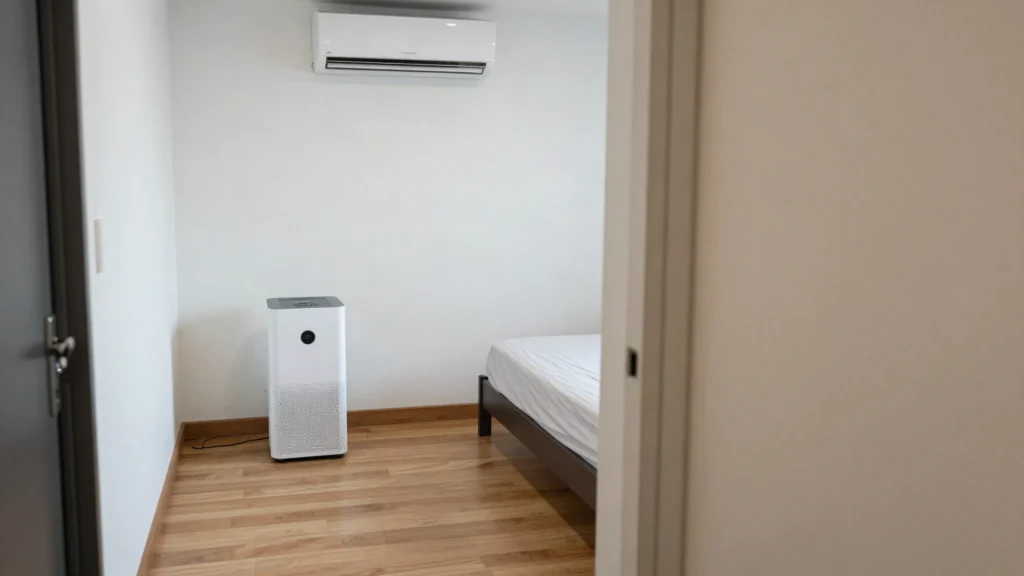
Thailand’s Department of Health gives simple placement rules:
- Keep it at least about 10 cm from the wall so air can flow in from all sides
- Do not put it under the air-con, against the headboard or by the bathroom door
- Close doors and windows while it runs: a purifier only cleans the air of a closed room
- Change the filter on schedule, and choose a machine with the TIS (มอก.) safety mark
Our own tip: switch it on a while before you go to bed and leave it in auto mode all night. When Air4Thai shows blue or green outside, open the windows to air the room.
A purifier is only part of the answer. See the free and low-cost ways to cut dust in PM2.5 at home: 8 ways to reduce dust in your bedroom.
Common mistakes
- Trusting the m² on the box. Divide the CADR by 12 to get the real room size.
- Buying a small machine and running it flat out. It is noisy and wears out the filter. A machine slightly bigger than the room on a medium speed works better.
- Pushing it into a corner. It cannot draw in air properly.
- Leaving the window open. Dust comes in faster than the machine can clean it.
- Using a filter past its life. A clogged filter cuts the CADR sharply.
- Expecting it to kill every smell. The carbon layer in small machines reduces odours to a point, but is not built for cigarette smoke or strong, constant smells.
How the brands differ
Xiaomi
The best CADR per baht in Thailand, with an app and sensor on almost every model. Be aware that Xiaomi does not grade its filters to a HEPA standard, and the bigger 4 Pro and Elite have an ionizer.
Sharp
Known for Plasmacluster and long-life filters, but Sharp Thailand does not publish CADR figures, which makes comparison hard. The larger FP-J40TA (30 m²) was on sale for ฿6,990 when we checked.
Philips
Most Thai models are filter-only with no ionizer, they are quiet, and many come with a 2-year warranty, but the price per unit of CADR is higher than Xiaomi.
LG
The PuriCare 360 uses an H13 filter and draws air from all sides, which suits big rooms, but it has an ionizer, and you should check the filter price first.
Hatari
A Thai brand with a long 3-year warranty and fair prices. It does not publish CADR, but the AP12R1 matched its label in Chaladsue’s test.
Blueair and Dyson
The Blueair Blue Max 3250 uses very little power (about 20 W at most) and is quiet, but its filter costs about ฿2,200–2,300. The Dyson HushJet Purifier Compact, at ฿15,900–19,900, delivers a CADR of about 250 m³/h, close to the much cheaper Philips AC0950. Its selling point is a filter Dyson says lasts 5 years.
Models that failed the test
In Chaladsue’s test, 4 models measured below their label: the Levoit Core 200S, Smarthome AP-180, Worldtech WT-P50 and IRIS OHYAMA AAP-S26B. Chaladsue also points out that the compulsory TIS 60335 mark covers electrical safety only. The performance standard, TIS 3061-2563, is still voluntary.
Our take
For most city homes, the best air purifier is the one sized for the room you spend the most time in, which is usually the bedroom. Measure the floor area, multiply by 12, and choose a model with a CADR above that number.
If you do not want to think about it, the Xiaomi 4 Lite covers most bedrooms for under ฿4,000. For living rooms, step up to the LG PuriCare 360 Hit. If you want silence and no ionizer, the Philips AC0950 is worth paying extra for. And remember: a purifier only works in a closed room.
To cut dust and allergens in the bedroom further, read our guides to the best dust mite vacuums and the best robot vacuums.
Frequently asked questions
Do air purifiers really help with PM2.5?
Yes, if the machine is sized for the room and the doors and windows are closed. A machine with a fine filter and enough CADR keeps bringing the dust level down, but it cannot keep up if the room is open to the outside air.
Should I leave it on all day, and how much electricity does it use?
During heavy-dust periods, run it in auto mode whenever you are in the room. The machines in this guide draw 23–60 W at most. At top speed for 8 hours a day, that is about ฿23–61 a month, and less in auto mode.
I have air-con. Do I still need an air purifier?
A home air-con filter is designed to catch coarse dust to protect the unit, not fine particles like PM2.5. If you want to cut the dust in the room seriously, use a purifier as well.
How often should I change the filter during the dust season?
Follow the machine’s or the app’s alert. After weeks of running all day, filters usually wear out sooner than the box says. If the filter turns dark or the airflow drops clearly, it is time.
What is the difference between Plasmacluster and UV-C, and do I need them?
Plasmacluster releases ions into the air, while UV-C is a lamp inside the machine. Both are extras and do not catch PM2.5 the way a filter does. With young children or anyone with asthma at home, we recommend filter-only models.
Which type suits young children or older people?
Choose a model without an ionizer, quiet in sleep mode, with enough CADR for the room, such as the Xiaomi 4 Lite or Philips AC0950. For older people who prefer not to use an app, the Hatari AP12R1 or Sharp FP-J30TA are easier.
What is the difference between an air purifier and a dehumidifier?
An air purifier filters dust and allergens from the air but does not lower humidity. If the room is damp or has mould, a dehumidifier is the better fit. Some homes need both.
What does the TIS (มอก.) mark on an air purifier mean?
The compulsory TIS 60335 mark certifies electrical safety. It does not certify that the machine filters dust as advertised. The performance standard is TIS 3061-2563, which is still voluntary.
How is buying from an official shop different?
Official shops give you a Thai service-centre warranty and genuine filters. Grey imports may be cheaper, but claims are harder and some filters are hard to find.