If you sneeze every morning when you wake up, or your nose is itchy or blocked on and off, the cause may be your own mattress. According to Siriraj Hospital’s Faculty of Medicine, about 30% of Thais have allergic rhinitis, and dust mites are the most common airborne allergen. Among allergy patients, 70–90% of adults are allergic to dust mites.
Thailand’s hot, humid climate suits dust mites particularly well. They thrive at 70–80% relative humidity, while Thailand’s yearly average is around 73–75% and climbs to about 85% in the rainy season. Mattresses, pillows and blankets are an ideal home for them all year round.
Dust mite vacuums do help, but not every feature on the box works as well as advertised, especially UV light. We compared 7 dust mite vacuums sold in Thailand, looked at which features really matter, and explain how to use one together with washing your bedding the right way.
How we made this comparison
We chose models sold through major retailers in Thailand, checked prices and specs at HomePro and on the brands’ websites on 13 October 2026. We did not lab-test the machines, and the scores are our editors’ scores. Prices in Thailand change quickly, so check again before you buy. How we choose
The 30-second answer
- Best overall Xiaomi Dust Mite Vacuum Cleaner complete specs, 50°C hot air and UV that switches off when you lift the machine about ฿1,790
- Best value Deerma CM800 13,000 Pa suction at 1.4 kg, the model most Thai homes know about ฿999
- Safest UV iSUPER H1-MAX UV works only when pressed on the mattress and stops as soon as you lift it about ฿4,990
- No UV wanted IRIS OHYAMA IC-FAC3 a sensor tells you if there is still dust, and there is no UV lamp about ฿1,790–2,490
- Several beds Deerma CM980 0.6 L dust bin, the largest at this price about ฿1,590
- Long warranty SCE PLUS MR1 2-year warranty on the body and motor about ฿1,099–1,990
- Cheapest EKONO JJ603 under ฿1,000 from a major retailer about ฿799
Numbers to know about dust mites in Thailand
70–90%of Thai adults with allergies are allergic to dust mites (Siriraj)
60°Cthe water temperature that kills all dust mites when you wash bedding
60 minhow long UV-C must shine at 10 cm to kill all adult mites in the lab
Dust mite vacuum comparison table: 7 models
| Model | Suction / power | Beats per min | UV / auto-off | Hot air | Price (฿) |
|---|---|---|---|---|---|
| Xiaomi Dust Mite Vacuum | 12,000 Pa / 350 W | 12,000 | Yes / auto-off | 50°C | ~1,790 |
| Deerma CM800 | 13,000 Pa / 450 W | 8,000 | Yes / not stated | temperature not stated | ~999 |
| iSUPER H1-MAX | 15,000 Pa / 500 W | 36,000 | Yes / auto-off | not stated | ~4,990 |
| IRIS OHYAMA IC-FAC3 | not stated / 400 W | 7,000 | No | not stated | 1,790–2,490 |
| Deerma CM980 | 13,000 Pa / 450 W | 12,600 | Yes / not stated | Yes | ~1,590 |
| SCE PLUS MR1 | 11,000 Pa / 400 W | not stated | Yes / not stated | not stated | 1,099–1,990 |
| EKONO JJ603 | 11,000 Pa / 300 W | not stated | Yes / not stated | not stated | ~799 |
The 7 dust mite vacuums, reviewed in detail
No. 1
Best overall
Xiaomi Dust Mite Vacuum Cleaner (BHR8279TH)
4.5/5 our score
About ฿1,790 (list price ฿1,899)
- Suction12,000 Pa
- Power350 W
- Beating12,000 per minute
- UVUV-C 254 nm, switches off when lifted
- Hot air50°C
- Filter4 layers, 99% at 0.3–10 microns
- Dust bin0.3 L
- Cord3.5 m
- Weightabout 1.6 kg
Pros
- The most complete specs for under ฿2,000
- UV switches off when lifted, lowering the risk to your eyes
- Xiaomi publishes detailed specs and test conditions
Cons
- Small 0.3 L bin, so you empty it often for several beds
- No dust sensor
Our verdict: If you buy one machine for the beds at home, this one gives you everything you need at an accessible price, and replacement filters are sold at official shops.
No. 2
Best value
Deerma CM800
4.2/5 our score
About ฿999 (list price ฿1,300)
- Suction13,000 Pa
- Power450 W
- Beating8,000 per minute
- UVyes (the product page does not say it switches off when lifted)
- Filter2-layer HEPA (grade not stated)
- Dust bin0.4 L
- Weight1.4 kg
Pros
- Strong suction for under ฿1,000
- Among the lightest, easy on tall mattresses
- Easy to buy and to find parts for
Cons
- Lower beating rate than the others
- Not stated whether the UV switches off when lifted, so never point it at your eyes
Our verdict: Good for a first dust mite vacuum on a tight budget. Some shops list it as cordless, but HomePro says it has a power cord, so we treat it as corded.
No. 3
Safest UV
iSUPER H1-MAX
4.3/5 our score
About ฿4,990
- Suction15,000 Pa
- Power500 W
- Beating36,000 per minute
- UVUV-C only when pressed on the mattress, stops when lifted
- Otherultrasonic, dust level display
- Dust bin0.35 L
- Weight2.05 kg
Pros
- The clearest UV safety system in this guide
- High suction and beating rate
- Display shows the dust level
Cons
- The most expensive here
- Small dust bin
Our verdict: Suits homes with children or pets where UV in the eyes is a worry. If you do not want UV at all, the IRIS OHYAMA IC-FAC3 is better value.
No. 4
Best if you do not want UV
IRIS OHYAMA IC-FAC3
4.0/5 our score
About ฿1,790–2,490 (list price ฿3,300)
- Power400 W
- Beating7,000 per minute
- UVnone
- Sensoryes, shows whether it is still picking up dust
- Filtrationcyclone
- Dust bin0.2 L
- Cord4 m
- Weight1.6 kg
Pros
- An affordable dust sensor that tells you when you have done enough
- Japanese brand with a 4 m cord
- No UV lamp to worry about
Cons
- Small dust bin
- The price moves fast: we saw ฿1,790 and ฿2,490 on the same day
Our verdict: In real use, a dust sensor is more useful than UV, because it tells you to keep going on a spot until the dust drops. Good for anyone who wants a simple machine that works.
No. 5
Best for several beds
Deerma CM980
4.1/5 our score
About ฿1,590 (list price ฿1,990)
- Suction13 kPa (13,000 Pa)
- Power450 W
- Beating12,600 per minute
- UVUV-C
- Heatyes (temperature not stated)
- Dust bin0.6 L
- Weight2 kg
Pros
- The largest bin under ฿2,000
- Beats faster than the CM800
- Has both UV-C and heat
Cons
- Heavier than the small models
- The product page does not state the filter type or cord length
Our verdict: Suits homes that do several beds or a sofa in one go, without stopping to empty the bin.
No. 6
Long warranty
SCE PLUS MR1
3.8/5 our score
About ฿1,099 on sale (list price ฿1,990)
- Suction11,000 Pa
- Power400 W
- UVyes
- FilterHEPA
- Dust bin0.2 L
- Cord4 m
- Weight1.5 kg
- Warranty2 years on the body and motor
Pros
- 2-year warranty, longer than similarly priced models
- HEPA filter
- Long cord
Cons
- Lower suction than the group
- Small dust bin
Our verdict: Good value on sale near ฿1,000. If the price goes back to almost ฿2,000, the Xiaomi offers better specs for about the same money.
No. 7
Cheapest
EKONO JJ603
3.6/5 our score
About ฿799 (list price ฿1,590)
- Suction11,000 Pa
- Power300 W
- UVyes
- Dust bin0.2 L
- Cord4 m
- Weight1.4 kg
- Warranty1 year on the motor
Pros
- The cheapest from a major retailer
- Light, with a long cord
Cons
- Beating rate, filter type and UV safety not stated
- Small dust bin
Our verdict: Fine if the budget is really tight, but for ฿200 more the Deerma CM800 gives you more suction and a bigger bin.
Which one should you buy?
| Your situation | Look for | Our pick |
|---|---|---|
| Dust mite allergy, want the most complete machine under ฿2,000 | fast beating, hot air, fine filter | Xiaomi Dust Mite Vacuum |
| Budget under ฿1,000 | suction of 10,000 Pa or more | Deerma CM800 |
| Young children or pets at home | UV that works only on contact, or no UV | iSUPER H1-MAX or IRIS IC-FAC3 |
| Several beds or a sofa too | large dust bin | Deerma CM980 |
| First purchase, not sure how often you will use it | fair price and decent warranty | SCE PLUS MR1 on sale |
| You already own a good cordless vacuum | a mattress tool | Use it with hot-washed bedding; you may not need to buy anything |
| You suspect bed bugs | professional treatment | A dust mite vacuum alone is not enough |
Does UV light really kill dust mites?
Almost every model in Thailand claims to kill 99% of mites or germs with UV-C, but those figures come from manufacturers’ lab tests under conditions very different from real use.
A 2012 study by Malaysia’s Institute for Medical Research found that UV-C at 254 nm had to shine for 60 minutes at 10 cm to kill all adult mites. At 55 cm, even after 60 minutes, only 27–58% died, and fewer still when dust or food debris covered them. The researchers concluded that UV-C only reaches the surface and is not yet practical for mattresses.
A dust mite vacuum passes over each spot for only a few seconds, so its UV is an extra. What actually works is beating the mites and their droppings out of the fabric, then catching them in a fine enough filter.
Keep UV-C away from your eyes. If the lamp does not switch off when you lift the machine, never turn it face up while it is on, and keep it out of children’s reach.
How to choose a dust mite vacuum: 6 points
1. Beating matters more than UV
Mites cling to the fibres. Fast beating shakes them loose so the machine can suck them up. Models that state a rate (for example 12,000 beats a minute or more) are easier to judge than ones that just say “powerful beating”.
2. Suction of 10,000 Pa or more
The models here range from 11,000 to 15,000 Pa, which is enough for a mattress. The wattage only tells you power use, not suction.
3. A fine, well-sealed filter
Mite droppings are tiny. A coarse or leaky filter blows the allergens back into the room. Look for HEPA or a stated filtration efficiency, and check the replacement filter price. Xiaomi recommends changing its filter every 2–3 months.
4. UV that switches off when lifted
If you want UV, pick a model that clearly says the lamp turns off when lifted, such as the Xiaomi or the iSUPER H1-MAX.
5. Corded or cordless
Almost all dust mite vacuums sold by major retailers in Thailand are corded, which gives steady suction and no battery worries. If you want cordless, watch out for weak suction and batteries that run out before every bed is done.
6. Weight and bin size
Doing a mattress properly means holding the machine for several minutes, so models under about 1.6 kg are more comfortable. For several beds, a 0.4–0.6 L bin saves stopping to empty it.
Getting rid of dust mites takes more than vacuuming
A New Zealand study (2012) found that vacuuming mattresses every day for 8 weeks cut mite allergen by about 85%, while a Mahidol University study in dormitories found plenty of allergen left even after vacuuming with high-suction machines. Both point the same way: a vacuum is one tool, and it has to be combined with others.
| What to do | How often | Why |
|---|---|---|
| Wash sheets, pillowcases and duvet covers at 55–60°C | every 1–2 weeks | 60°C kills all mites, while most survive at 40°C |
| Vacuum mattresses, pillows and sofas | at least weekly, 2–3 times a week in the rainy season | pulls mites and droppings out of the fabric |
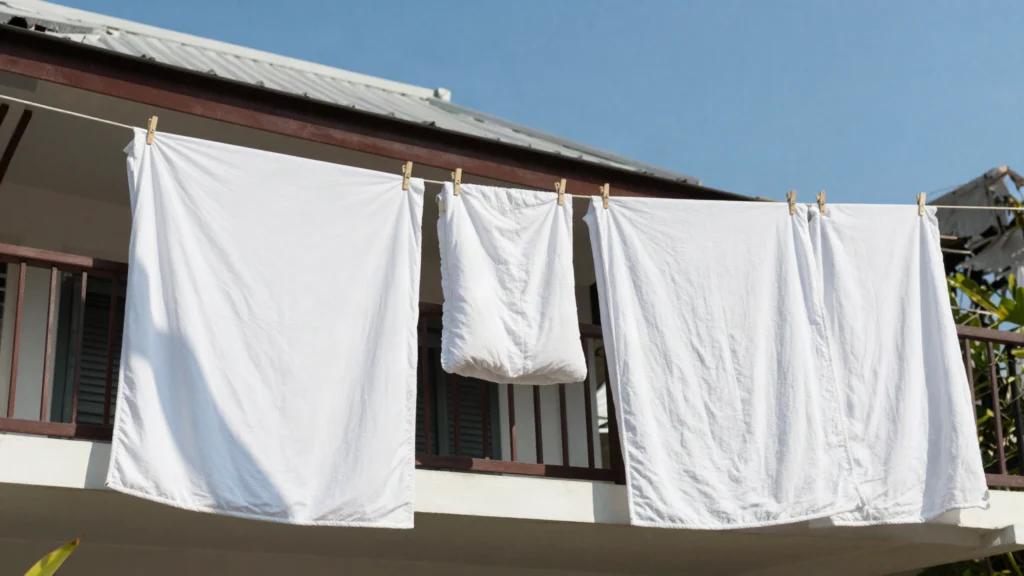
| Air mattresses, pillows and blankets in strong sun | weekly, for several hours | lowers humidity, but the sun rarely reaches 60°C, so it cannot replace a hot wash |
| Use mite-proof pillow and mattress covers | all the time | keeps mites in the filling from reaching your skin |
| Keep bedroom humidity below 50% | always, especially in the rainy season | mites do poorly below 50% humidity |
To set up the whole bedroom so mites struggle, from the mattress to the curtains and soft toys, see the room-by-room checklist in A bedroom for dust mite allergies: how to set it up.
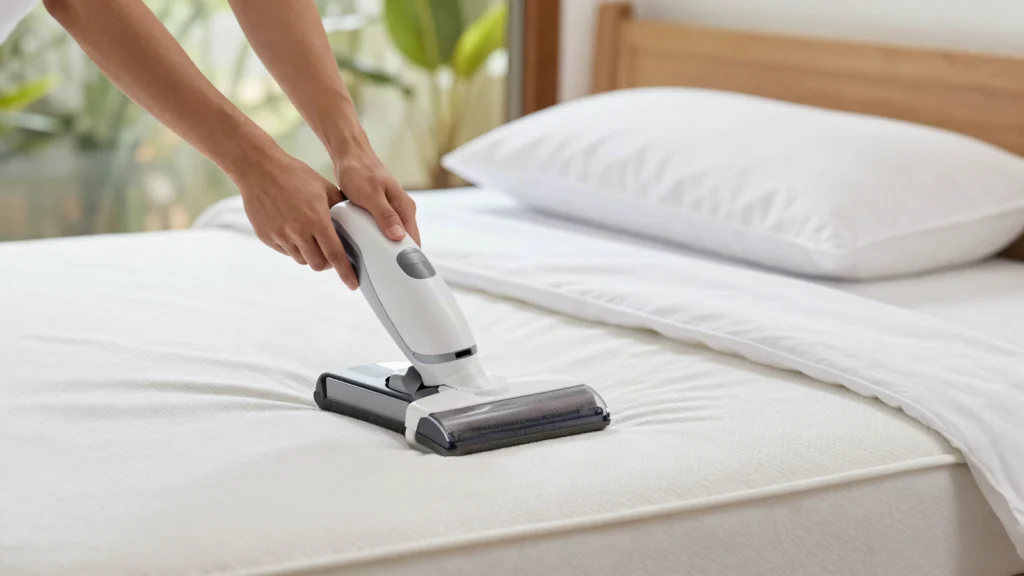
How to vacuum a mattress properly
- Strip the sheets and pillowcases for washing first, then vacuum the bare mattress
- Move slowly in overlapping rows so the machine can beat and suck each spot long enough
- Focus on seams, edges and where your head usually rests
- Flip the mattress and repeat once a month
- Empty the bin outside the bedroom, and wash or tap out the filter as the manual says
Xiaomi vs Deerma: what is the difference?
This is the question we hear most. The spec page of the Xiaomi Dust Mite Vacuum Cleaner Pro cites test results from “Deerma Laboratory”, which suggests Deerma makes or develops dust mite vacuums for Xiaomi. The visible difference is that Xiaomi gives more detailed specs and UV safety information, while Deerma has several cheaper models such as the CM800 and CM980.
Jimmy and Dyson
The Jimmy WB55, at about ฿4,390, beats very fast and has a wide head, but its product page did not state suction when we looked. The Dyson V8 Absolute is a general cordless vacuum, ฿13,900 in the October promotion (normally ฿18,900), and the Thai box does not include a mattress tool, so it is not good value if you are buying for dust mites.
Our take
For most homes, the Xiaomi Dust Mite Vacuum Cleaner is the best balance. If money is really tight, the Deerma CM800 does the basics well for under ฿1,000. With young children at home, choose a model whose UV switches off, or one without UV.
Whichever you buy, the best results come from washing your bedding hot every 1–2 weeks, using mite-proof covers and controlling humidity. If your allergy symptoms stay severe, see a doctor: a dust mite vacuum is not a treatment.
To cut airborne dust in the bedroom too, read our guide to the best air purifiers in Thailand.
Frequently asked questions
How is a dust mite vacuum different from a normal vacuum?
A dust mite vacuum has a beating head that shakes mites out of the fabric, a wide flat nozzle for mattresses and a fine filter so allergens are not blown back out. A normal vacuum with a mattress tool and a good filter can do part of the job.
Do dust mite vacuums really reduce allergies?
They cut the number of mites and allergens on the mattress, but work best together with hot-washing your bedding, mite-proof covers and humidity control. They do not replace medical treatment.
Does the UV light kill dust mites?
In the lab, UV-C had to shine for about 60 minutes at close range to kill all adult mites. A few seconds of vacuuming has a limited effect, so treat UV as an extra.
Is UV-C safe around children and pets?
UV-C harms eyes and skin. Choose a model whose lamp switches off when lifted, such as the Xiaomi or iSUPER H1-MAX, or one without UV, and keep it out of children’s reach.
How often should I vacuum my mattress for mites?
At least once a week, and 2–3 times a week in the humid rainy season. The study with the best results vacuumed every day.
How many Pa of suction is enough?
For a mattress, 10,000–15,000 Pa is enough. Beating, the filter and vacuuming slowly matter more than the highest suction figure.
How often should I change the filter?
Follow each model’s manual. Xiaomi recommends every 2–3 months. If the filter is washable, let it dry completely before putting it back.
Is sunlight alone enough?
No. Sun lowers humidity and is a good extra, but it rarely reaches the 60°C that reliably kills mites, so hot washing is still needed.